
A superior approach to quantum advantage
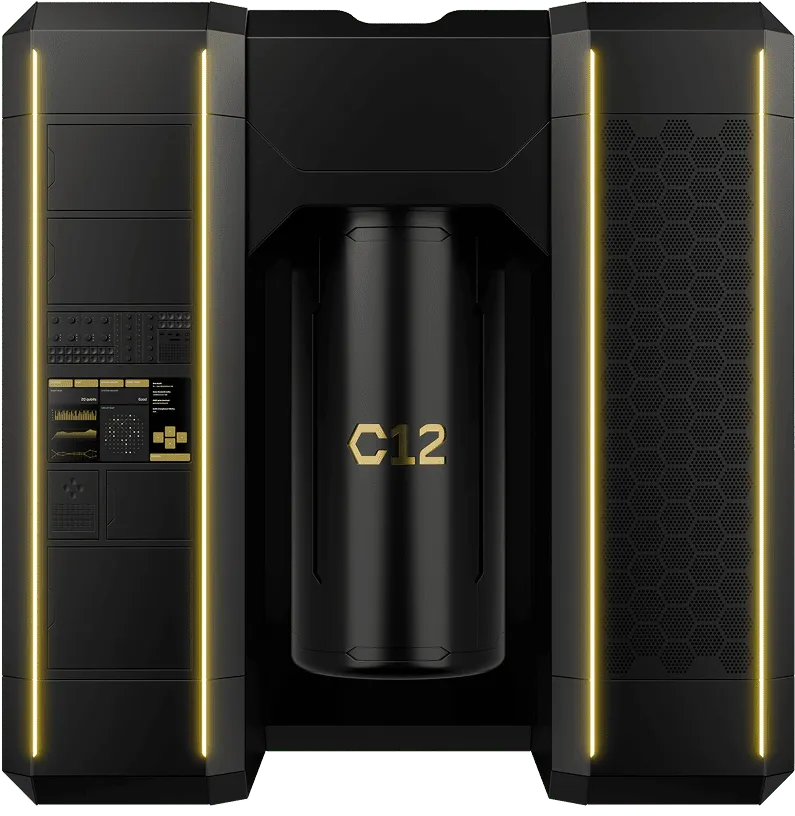
Inside a C12 quantum computer
- At the core lies our Quantum Processing Unit (QPU), powered by carbon nanotube spin qubits that combine atomic-level purity with fast, solid-state control.
- A superconducting quantum bus links qubits across the chip, enabling selective, long-range entanglement while minimizing noise.
- Our low-level operating software manages real-time calibration and error correction, ensuring stable, high-performance operation.
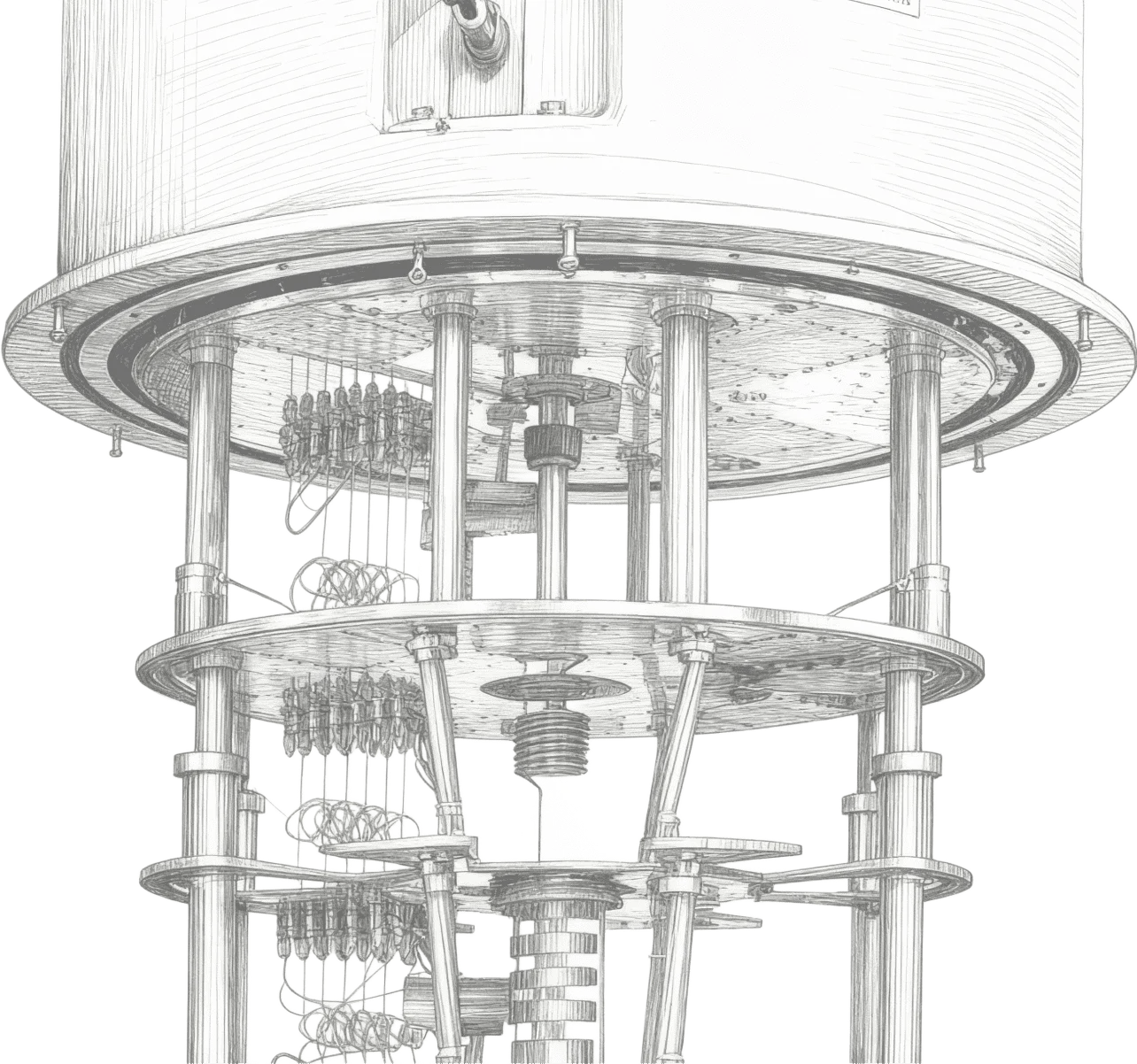
Overcoming quantum noise through material purity
.webp)
.webp)
.webp)


Connectivity for scalability
Connections occur because qubits can be selectively coupled to each other through a superconducting microwave resonator that we call a quantum bus. The key word here is selectively! A carbon nanotube spin qubit can be placed in either a “memory” mode or a “connected” mode
%20(1).png)
Efficient quantum error correction codes (such as bivariate bicycle or balanced product codes) require much better connectivity than the nearest-neighbor approach common among superconducting and semiconductor spin qubits. These codes also demand higher qubit quality than the 2D surface code. It’s the unique combination of higher connectivity and higher fidelity that makes the carbon nanotube qubit so powerful.
Qubit operation
Gate electrodes are used to form a double quantum dot within the nanotubes, where a single electron is trapped. This is the basis for our qubits.
Using a magnetic gate electrode, we add a magnetic field that entangles the electronic spin with the charge dipole in the double quantum dot. This makes a spin qubit.
The spin qubit is then addressed via microwave pulses to the control electrodes.
FAQ
Carbon nanotubes avoid a huge amount of the noise that plagues qubits and creates errors in quantum computing by hosting a spin qubit in a simple, isolated, and ultra-pure material. They enjoy the benefits of being solid-state, just like traditional computers, because no ions or atoms need to be trapped and moved. But unlike other solid-state qubits, their contact with the outside environment is minimal. It is the closest realization of a single spin in vacuum. So a nanotube-based quantum computer starts from a baseline of a low error rate.
Unlike most qubits, nanotubes can support a quantum bus that provides high connectivity among qubits. The importance isn’t as obvious in the current era of tens of qubits, but becomes critical for error correction with larger numbers of qubits, as it drastically reduces both computation time and the impact of noise.
There are qubit technologies that enjoy high fidelity, or high connectivity, or in rare cases both. But the challenge is in doing these things in a scalable manner, and that’s where the real advantage with this technology lies. Carbon nanotube-based qubits are both small and compatible with semiconductor fabrication techniques.
No, part of the challenge in using nanotubes is that creating the same ones reproducibly requires great expertise. Nanotubes vary in aspects like structure (single- versus multi-walled), length, diameter, chirality, semiconducting bandgap, contaminants, and vacancies. They also vary in their ratio of carbon isotopes; to effectively eliminate nuclear spin noise, we use an ultra-pure carbon-12 isotope. C12’s proprietary nanotube growth procedures, perfected over many years, are an essential step that allows the use of carbon nanotubes as qubits.
Producing high-quality nanotubes only serves as a starting point, however. Unlike with most qubit technologies, C12 is able to pre-select amongst those nanotubes through a rapid characterization process built on state-of-the-art technologies. Only nanotubes meeting stringent requirements are incorporated into the QPU.
This unique ability to evaluate and select the exact material used for each qubit mitigates serious challenges faced by superconducting or other spin qubits that are obliged to accept the consequences of manufacturing variability. The lowest-performing qubits are the limiting factor for logical qubit error rates.
C12's lower variability leads to higher qubit fidelity, which means fewer physical qubits are necessary to create a logical qubit. That leads to faster logical gates, and more operations per second. The more operations per second, the more algorithms are feasible to run. It's a virtuous cycle.
These are fine options for experimenting with small quantum systems, but C12 is dedicated toward the long-term goal of a fault-tolerant quantum computer. One wouldn’t consider all the computer models from 1970 to 2020 as equivalent to each other; the same goes for quantum computers. There are a number of things that will be necessary in order for quantum computers to be capable of demonstrating quantum advantage in a useful way across a wide range of applications.
Those include:
- Lots of qubits. Error correction algorithms and desired computations will dictate how many physical qubits are ultimately necessary, but it is unlikely to be merely a few thousand.
- Speed. A perfectly working computer is only useful if it can complete your calculation within hours or days, at most.
- Low noise. Although it is theoretically possible to use error correction to correct the noise of mediocre qubits, the number of qubits necessary to fix those errors increases beyond real-world plausibility.
- Connectivity. If qubits can only communicate with their nearest neighbors, they have to play a game of telephone tag to communicate with distant qubits. That game is subject to the same problems that happen in real life: it takes time and the message gets garbled, in this case by quantum noise. Low-connectivity qubits don’t support a scalable approach.
There are many technical challenges to scale a quantum computer such as minimizing wiring, maintaining low temperatures, calibrating qubits, generating control signals, correcting errors from quantum noise, and reading out qubit values. None of these are trivial challenges and each order of magnitude increase in the number of qubits introduces new design constraints.
However, nanotube qubits are fundamentally small — they’re called nano-tubes for a reason — and consequently can support high qubit densities in a quantum processor. How high is high? We believe nanotube quantum processors can provide hundreds of thousands or even millions of physical qubits.
How many qubits will actually be necessary is a function of the advances in error correction that are made, and just like with classical computer software, the demands of the algorithms to be performed.
No, gate times for carbon nanotube-based qubits are measured in nanoseconds, not microseconds or longer. Qubits like neutral atoms and trapped ions that rely on physical movement can make excellent and high-quality test systems, but their utility for real-world use cases is limited by their ultimate speed.
Algorithms aren’t feasible if they take years. In the same way that classical computer power was for many years dictated by a race for higher clock speeds, once quantum computers are more mature the number of operations per second will be a defining factor.
The key to the connectivity in C12’s design is a superconducting microwave resonator. This serves as a “quantum bus” that allows qubit operations to occur across a distance, without the exponential increase in crosstalk that can be very limiting for technologies such as superconducting qubits.
Carbon nanotubes are well-known, but their fabrication in a controlled and reproducible way and their integration on a semiconductor chip are very difficult. C12 has an exclusive license on the patent by Centre national de la recherche scientifique (CNRS) that makes this possible.
C12 also leverages over a decade of research learnings from École Normale Supérieure as well as from C12’s own in-house nanofabrication lab and nanoassembly facilities.
Carbon nanotube qubits can benefit from many quantum error correction protocols by virtue of high connectivity and fidelity. For example, rather than rely on algorithms that demand high physical-to-logical qubit ratios (sometimes over 1000!) high connectivity affords far better ratios.
Quantum low density parity check codes are likely to provide ratios of tens of physical qubits per logical qubit. Due to the rapid advances in the error correction research landscape and the flexibility connectivity affords, C12 is not locked into a particular methodology.
C12 provides the underlying hardware and the low-level software to run it, such as most aspects of the transpiler. We partner with software experts that provide the higher-level circuit optimization and algorithm development.
It’s important to understand that quantum computing is a fundamentally different tool from anything that’s existed before. It won’t be a simple switch that turns all computations into faster quantum ones.
Consequently, it’s important to develop competence in it over time. The physics is not intuitive. Algorithms can’t be designed to abstract them away. Quantum algorithm development itself is in its infancy and there’s a huge dependence on the particulars of the hardware.
So this is clearly a capacity that needs to be developed within organizations, and it’ll take years of effort to have the best use cases identified and optimize algorithms to actually take advantage of the hardware that will be available. At the same time, an organization can also benefit from early collaboration with quantum companies on hard problems because it helps steer quantum development toward solving the problems of its industry.
Callisto is an emulator based on the design of C12’s quantum hardware. Thanks to the unique characteristics of carbon nanotubes, it is able to emulate the noise of the quantum system and realistically simulate the results of quantum circuit runs.
Callisto Discovery is currently available and free for use up to 13 qubits.